Friday, 24 January 2025

AZ-204 Question and Answer Part 12

Question #151
HOTSPOT
-

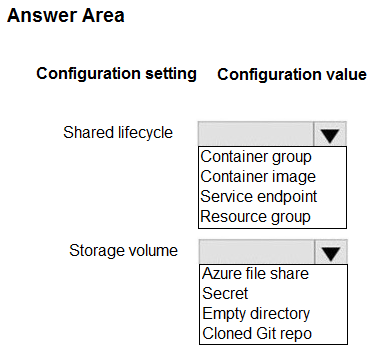
You are developing an application that includes two Docker containers.

The application must meet the following requirements:

• The containers must not run as root.
• The containers must be deployed to Azure Container Instances by using a YAML file.
• The containers must share a lifecycle, resources, local network, and storage volume.
• The storage volume must persist through container crashes.
• The storage volume must be deployed on stop or restart of the containers.

You need to configure Azure Container Instances for the application.

Which configuration values should you use? To answer, select the appropriate options in the answer area.

NOTE: Each correct selection is worth one point.

Correct Answer:

Question #152
You develop Azure Durable Functions to manage vehicle loans.

The loan process includes multiple actions that must be run in a specified order. One of the actions includes a customer credit check process, which may require multiple days to process.

You need to implement Azure Durable Functions for the loan process.

Which Azure Durable Functions type should you use?
  1. A
    orchestrator
  2. B
    client
  3. C
    entity
  4. D
    activity

Correct Answer:
A

The orchestrator function is indeed the best pick for managing a loan process in Azure Durable Functions, particularly because of its ability to coordinate and sequence multiple actions efficiently. This is crucial given the complexity of a vehicle loan process, which includes sequential tasks like credit checks that might extend over several days. Through the orchestrator function, these tasks are not only orchestrated logically but can also be set to interact with other functions, such as activity functions for specific tasks, maintaining an orderly execution in the specified sequence.


Question #153
HOTSPOT
-

You are developing an Azure Function app.

All functions in the app meet the following requirements:

• Run until either a successful run or until 10 run attempts occur.
• Ensure that there are at least 20 seconds between attempts for up to 15 minutes.

You need to configure the host.json file.

How should you complete the code segment? To answer, select the appropriate options in the answer area.

NOTE: Each correct selection is worth one point.

Correct Answer:

Question #154
You develop Azure Web Apps for a commercial diving company. Regulations require that all divers fill out a health questionnaire every 15 days after each diving job starts.

You need to configure the Azure Web Apps so that the instance count scales up when divers are filling out the questionnaire and scales down after they are complete.

You need to configure autoscaling.

What are two possible auto scaling configurations to achieve this goal? Each correct answer presents a complete solution.

NOTE: Each correct selection is worth one point.
  1. A
    Recurrence profile
  2. B
    CPU usage-based autoscaling
  3. C
    Fixed date profile
  4. D
    Predictive autoscaling

Correct Answer:
CD

The correct answer choices, C "Fixed date profile" and D "Predictive autoscaling," align perfectly with the needs stated in the question. The Fixed date profile is ideal as it allows for pre-scheduled scaling based on known busy periods every 15 days, meeting regulatory requirements efficiently. Predictive autoscaling complements this by adjusting the resources in anticipation of varying workloads, based on trends and patterns, ensuring the application matches real-time demand and provides seamless user experience during high traffic questionnaire completion times. These together ensure optimal resource utilization tailored to the specific operational cycles of the diving company.


Question #156
HOTSPOT
-

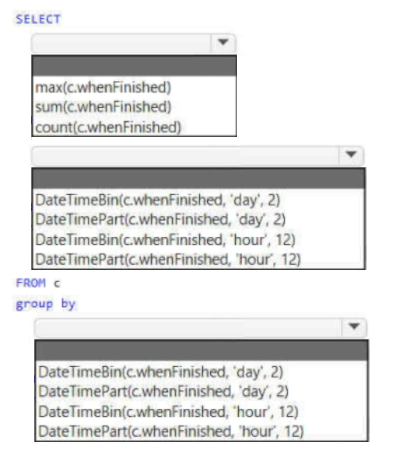
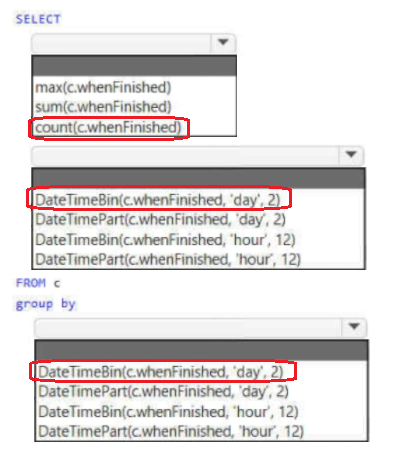
You develop an application that sells AI generated images based on user input. You recently started a marketing campaign that displays unique ads every second day.

Sales data is stored in Azure Cosmos DB with the date of each sale being stored in a property named ‘whenFinished’.

The marketing department requires a view that shows the number of sales for each unique ad.
You need to implement the query for the view.

How should you complete the query? To answer, select the appropriate options in the answer area.

NOTE: Each correct selection is worth one point.

Correct Answer:


Question #157
HOTSPOT
-

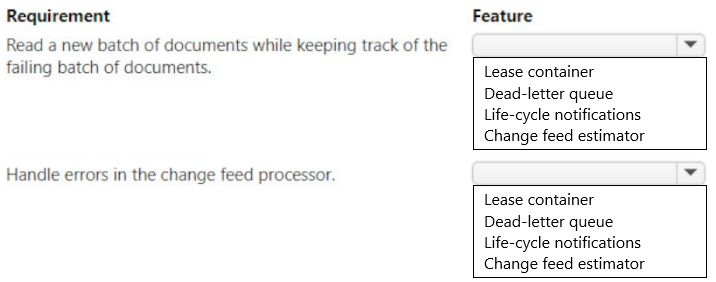
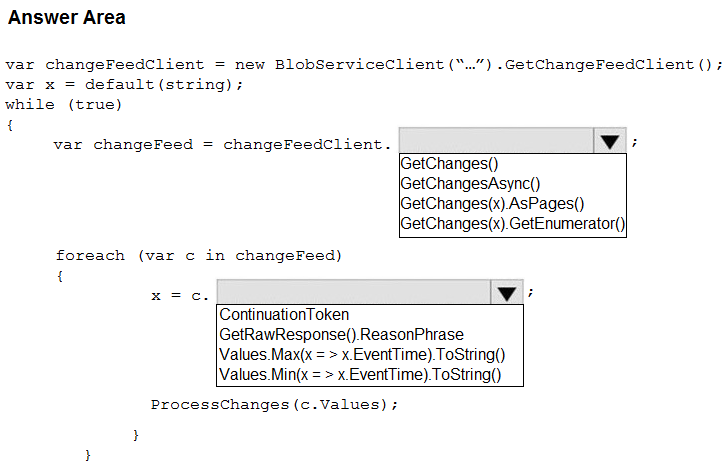
You implement an Azure solution to include Azure Cosmos DB, the latest Azure Cosmos DB SDK, and the Core (SQL) API. You also implement a change feed processor on a new container instance by using the Azure Functions trigger for Azure Cosmos DB.

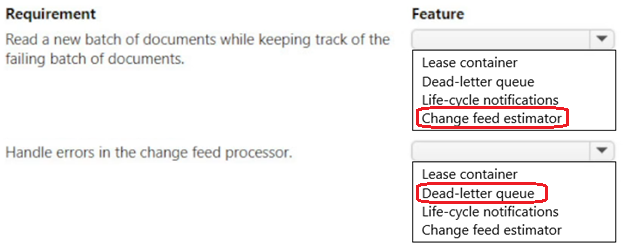
A large batch of documents continues to fail when reading one of the documents in the batch. The same batch of documents is continuously retried by the triggered function and a new batch of documents must be read.

You need to implement the change feed processor to read the documents.

Which feature should you implement? To answer, select the appropriate features in the answer area.

NOTE: Each correct selection is worth one point.

Correct Answer:


Question #158
You are developing an application to store business-critical data in Azure Blob storage.

The application must meet the following requirements:

• Data must not be modified or deleted for a user-specified interval.
• Data must be protected from overwrites and deletes.
• Data must be written once and allowed to be read many times.

You need to protect the data in the Azure Blob storage account.

Which two actions should you perform? Each correct answer presents part of the solution.

NOTE: Each correct selection is worth one point.
  1. A
    Configure a time-based retention policy for the storage account.
  2. B
    Create an account shared-access signature (SAS).
  3. C
    Enable the blob change feed for the storage account.
  4. D
    Enable version-level immutability support for the storage account.
  5. E
    Enable point-in-time restore for containers in the storage account.
  6. F
    Create a service shared-access signature (SAS).

Correct Answer:
AF

The correct options to ensure data protection in Azure Blob Storage, based on the user requirements, are indeed A) Configure a time-based retention policy for the storage account and D) Enable version-level immutability support for the storage account. Option A provides a Write-Once, Read-Many (WORM) capability, locking the data from modifications or deletions during the specified retention period. This directly supports two needs: preventing overwrites and deletions, and specifying a user-defined immutable period. Option D is essential to apply option A at the version level, further safeguarding each version of the blob against modifications or deletions beyond general immutability settings, aligning with the application’s strict data protection requirements.


Question #159
You are updating an application that stores data on Azure and uses Azure Cosmos DB for storage. The application stores data in multiple documents associated with a single username.

The application requires the ability to update multiple documents for a username in a single ACID operation.

You need to configure Azure Cosmos DB.

Which two actions should you perform? Each correct answer presents part of the solution.

NOTE: Each correct selection is worth one point.
  1. A
    Create a collection sharded on username to store documents.
  2. B
    Configure Azure Cosmos DB to use the Gremlin API.
  3. C
    Create an unsharded collection to store documents.
  4. D
    Configure Azure Cosmos DB to use the MongoDB API.

Correct Answer:
CD

When configuring Azure Cosmos DB to handle updates across multiple documents in a single ACID transaction, it's important to focus on the partitioning and API selection. Opting for an unsharded collection ensures that all documents reside in the same logical partition, crucial for maintaining ACID properties during transactions. Additionally, using the MongoDB API is advantageous as it supports multi-document ACID transactions, allowing the application to perform complex updates consistently and reliably across various documents linked by username.


Question #160
You develop Azure solutions.

You must connect to a No-SQL globally-distributed database by using the .NET API.

You need to create an object to configure and execute requests in the database.

Which code segment should you use?
  1. A
    database_name = 'MyDatabase'
    database = client.create_database_if_not_exists(id=database_name)
  2. B
    client = CosmosClient(endpoint, key)
  3. C
    container_name = 'MyContainer'
    container = database.create_container_if_not_exists(
    id=container_name, partition_key=PartitionKey(path="/lastName"), offer_throughput=400 )

Correct Answer:
C

Option B, which initializes the CosmosClient using the specified endpoint and key, is essential for setting up a client to interact with Azure Cosmos DB. This step is fundamental because it establishes the connection necessary to carry out any operations within the database, including creating databases and containers as seen in the other options. It's crucial to have the client set before configuring or executing any requests to ensure that the operations are directed towards the correct database context in Azure. Therefore, initializing CosmosClient first is not only a best practice but a prerequisite in the workflow of working with Cosmos DB using the .NET API.


AZ-204 Question and Answer Part 11


Question #141
HOTSPOT -
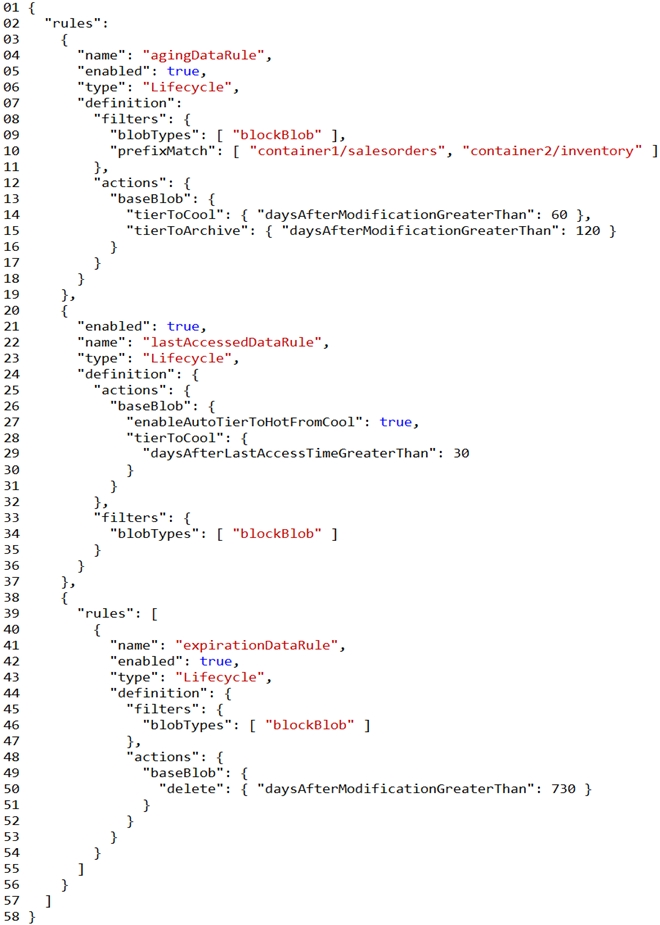
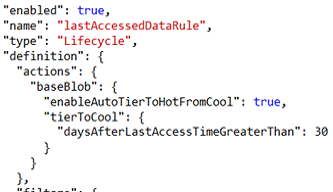
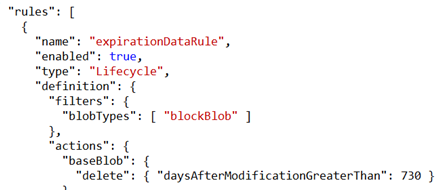
You are developing an application that uses a premium block blob storage account. You are optimizing costs by automating Azure Blob Storage access tiers.
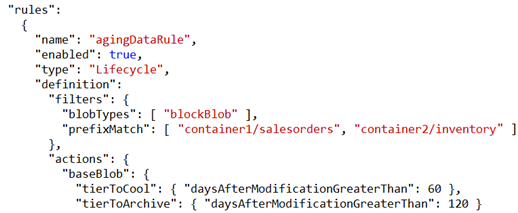
You apply the following policy rules to the storage account. You must determine the implications of applying the rules to the data. (Line numbers are included for reference only.)

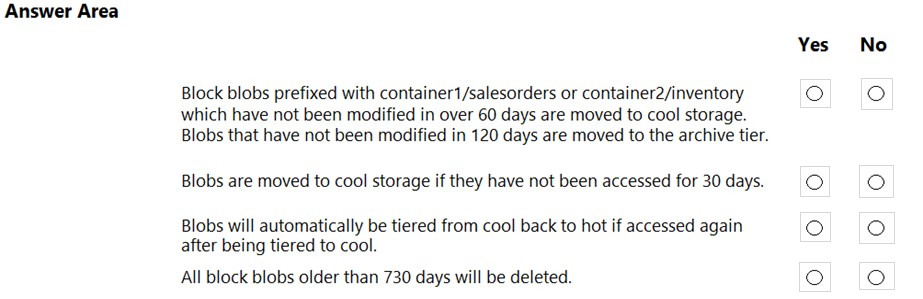
For each of the following statements, select Yes if the statement is true. Otherwise, select No.
NOTE: Each correct selection is worth one point.
Hot Area:


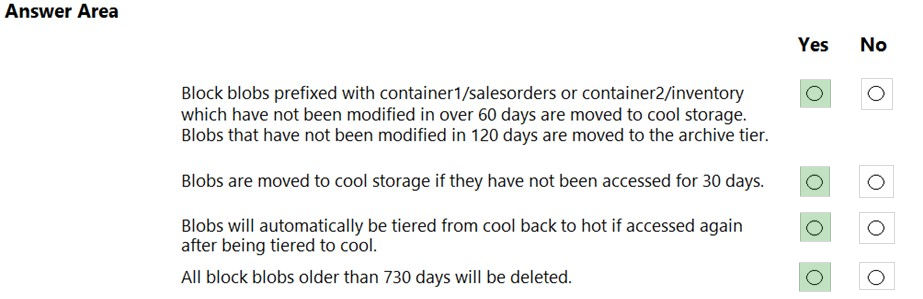
Correct Answer:

Box 1: Yes -


Box 2: Yes -


Box 3: Yes -

Box 4: Yes -

Question #142
You are developing a solution that will use a multi-partitioned Azure Cosmos DB database. You plan to use the latest Azure Cosmos DB SDK for development.
The solution must meet the following requirements:
✑ Send insert and update operations to an Azure Blob storage account.
✑ Process changes to all partitions immediately.
✑ Allow parallelization of change processing.
You need to process the Azure Cosmos DB operations.
What are two possible ways to achieve this goal? Each correct answer presents a complete solution.
NOTE: Each correct selection is worth one point.
  1. A
    Create an Azure App Service API and implement the change feed estimator of the SDK. Scale the API by using multiple Azure App Service instances.
  2. B
    Create a background job in an Azure Kubernetes Service and implement the change feed feature of the SDK.
  3. C
    Create an Azure Function to use a trigger for Azure Cosmos DB. Configure the trigger to connect to the container.
    Most Voted
  4. D
    Create an Azure Function that uses a FeedIterator object that processes the change feed by using the pull model on the container. Use a FeedRange object to parallelize the processing of the change feed across multiple functions.

Correct Answer:
AC
Azure Functions is the simplest option if you are just getting started using the change feed. Due to its simplicity, it is also the recommended option for most change feed use cases. When you create an Azure Functions trigger for Azure Cosmos DB, you select the container to connect, and the Azure Function gets triggered whenever there is a change in the container. Because Azure Functions uses the change feed processor behind the scenes, it automatically parallelizes change processing across your container's partitions.
Note: You can work with change feed using the following options:
✑ Using change feed with Azure Functions
✑ Using change feed with change feed processor
Reference:
https://docs.microsoft.com/en-us/azure/cosmos-db/read-change-feed


Question #143
HOTSPOT -
You have an Azure Web app that uses Cosmos DB as a data store. You create a CosmosDB container by running the following PowerShell script:
$resourceGroupName = "testResourceGroup"
$accountName = "testCosmosAccount"
$databaseName = "testDatabase"
$containerName = "testContainer"
$partitionKeyPath = "/EmployeeId"
$autoscaleMaxThroughput = 5000

New-AzCosmosDBSqlContainer -
-ResourceGroupName $resourceGroupName
-AccountName $accountName
-DatabaseName $databaseName
-Name $containerName
-PartitionKeyKind Hash
-PartitionKeyPath $partitionKeyPath
-AutoscaleMaxThroughput $autoscaleMaxThroughput
You create the following queries that target the container:
SELECT * FROM c WHERE c.EmployeeId > '12345'
SELECT * FROM c WHERE c.UserID = '12345'
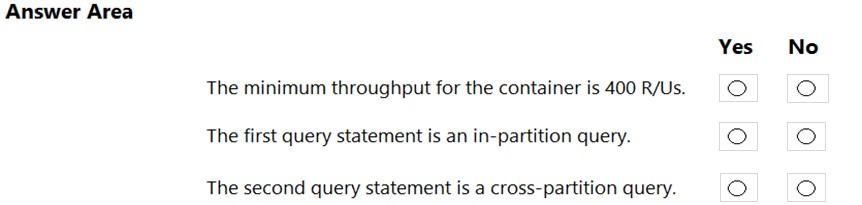
For each of the following statements, select Yes if the statement is true. Otherwise, select No.
NOTE: Each correct selection is worth one point.
Hot Area:


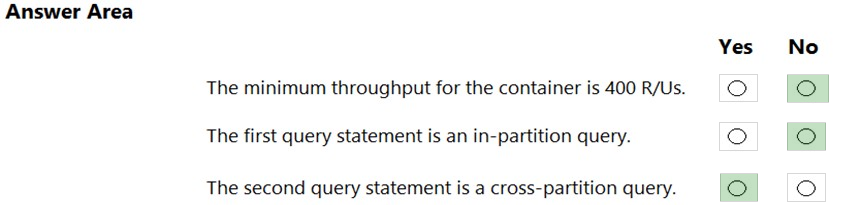
Correct Answer:

Box 1: No -
You set the highest, or maximum RU/s Tmax you don't want the system to exceed. The system automatically scales the throughput T such that 0.1* Tmax <= T <=
Tmax.
In this example we have autoscaleMaxThroughput = 5000, so the minimum throughput for the container is 500 R/Us.

Box 2: No -
First query: SELECT * FROM c WHERE c.EmployeeId > '12345'
Here's a query that has a range filter on the partition key and won't be scoped to a single physical partition. In order to be an in-partition query, the query must have an equality filter that includes the partition key:
SELECT * FROM c WHERE c.DeviceId > 'XMS-0001'

Box 3: Yes -
Example of In-partition query:
Consider the below query with an equality filter on DeviceId. If we run this query on a container partitioned on DeviceId, this query will filter to a single physical partition.
SELECT * FROM c WHERE c.DeviceId = 'XMS-0001'

Reference:
https://docs.microsoft.com/en-us/azure/cosmos-db/how-to-choose-offer https://docs.microsoft.com/en-us/azure/cosmos-db/how-to-query-container

Question #144
HOTSPOT -
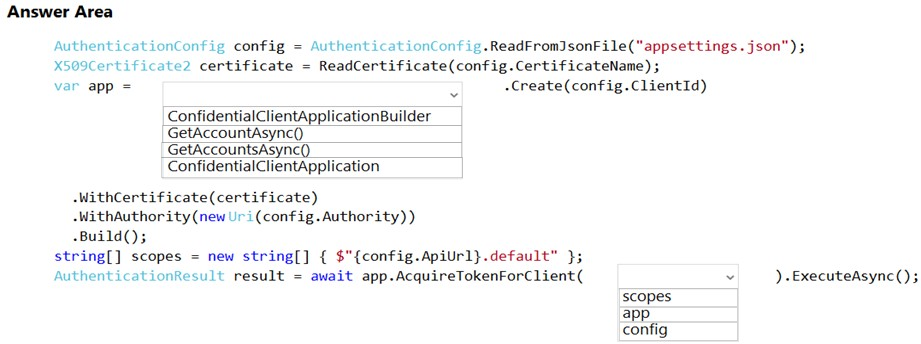
You are developing a web application that makes calls to the Microsoft Graph API. You register the application in the Azure portal and upload a valid X509 certificate.
You create an appsettings.json file containing the certificate name, client identifier for the application, and the tenant identifier of the Azure Active Directory (Azure
AD). You create a method named ReadCertificate to return the X509 certificate by name.
You need to implement code that acquires a token by using the certificate.
How should you complete the code segment? To answer, select the appropriate options in the answer area.
NOTE: Each correct selection is worth one point.
Hot Area:


Correct Answer:

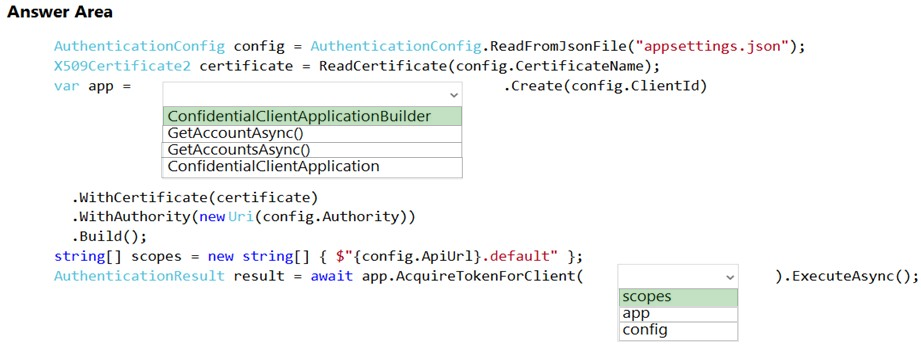
Box 1: ConfidentialClientApplicationBuilder
Here's the code to instantiate the confidential client application with a client secret: app = ConfidentialClientApplicationBuilder.Create(config.ClientId)
.WithClientSecret(config.ClientSecret)
.WithAuthority(new Uri(config.Authority))
.Build();

Box 2: scopes -
After you've constructed a confidential client application, you can acquire a token for the app by calling AcquireTokenForClient, passing the scope, and optionally forcing a refresh of the token.
Sample code: result = await app.AcquireTokenForClient(scopes)
.ExecuteAsync();

Reference:
https://docs.microsoft.com/en-us/azure/active-directory/develop/scenario-daemon-app-configuration https://docs.microsoft.com/en-us/azure/active-directory/develop/scenario-daemon-acquire-token


Question #145
HOTSPOT -
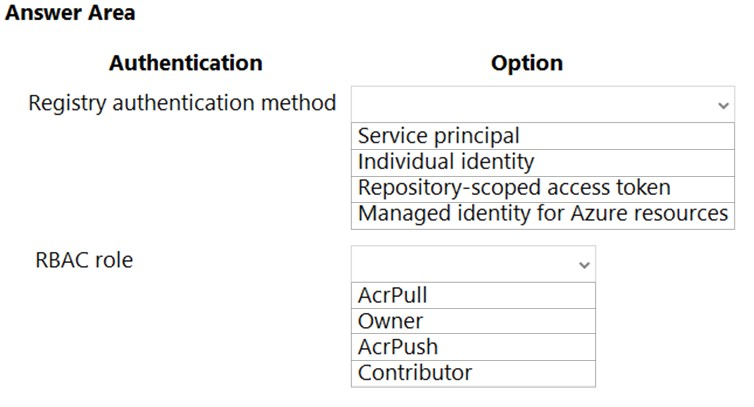
You develop a containerized application. You plan to deploy the application to a new Azure Container instance by using a third-party continuous integration and continuous delivery (CI/CD) utility.
The deployment must be unattended and include all application assets. The third-party utility must only be able to push and pull images from the registry. The authentication must be managed by Azure Active Directory (Azure AD). The solution must use the principle of least privilege.
You need to ensure that the third-party utility can access the registry.
Which authentication options should you use? To answer, select the appropriate options in the answer area.
NOTE: Each correct selection is worth one point.
Hot Area:


Correct Answer:

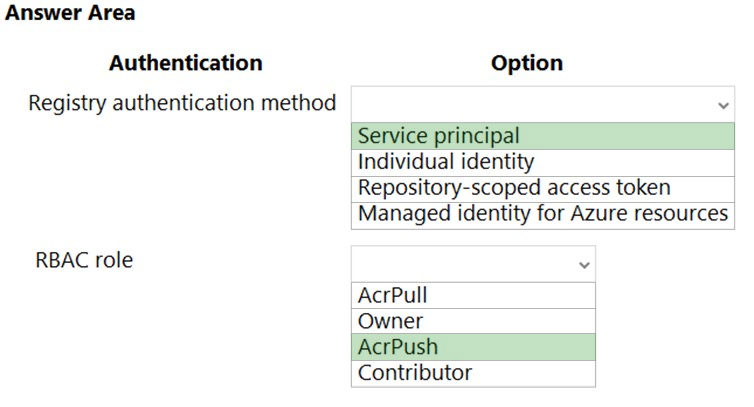
Box 1: Service principal -
Applications and container orchestrators can perform unattended, or "headless," authentication by using an Azure Active Directory (Azure AD) service principal.
Incorrect Answers:
✑ Individual AD identity does not support unattended push/pull
✑ Repository-scoped access token is not integrated with AD identity
✑ Managed identity for Azure resources is used to authenticate to an Azure container registry from another Azure resource.

Box 2: AcrPush -
AcrPush provides pull/push permissions only and meets the principle of least privilege.
Incorrect Answers:
AcrPull only allows pull permissions it does not allow push permissions.

✑ Owner and Contributor allow pull/push permissions but does not meet the principle of least privilege.

Reference:
https://docs.microsoft.com/en-us/azure/container-registry/container-registry-authentication?tabs=azure-cli https://docs.microsoft.com/en-us/azure/container-registry/container-registry-roles?tabs=azure-cli


Question #146
You deploy an Azure App Service web app. You create an app registration for the app in Azure Active Directory (Azure AD) and Twitter.
The app must authenticate users and must use SSL for all communications. The app must use Twitter as the identity provider.
You need to validate the Azure AD request in the app code.
What should you validate?
  1. A
    ID token header
  2. B
    ID token signature
  3. C
    HTTP response code
  4. D
    Tenant ID

Correct Answer:
A

Reference:
https://docs.microsoft.com/en-us/azure/storage/common/storage-auth-aad-app?tabs=dotnet

Question #147

HOTSPOT
-

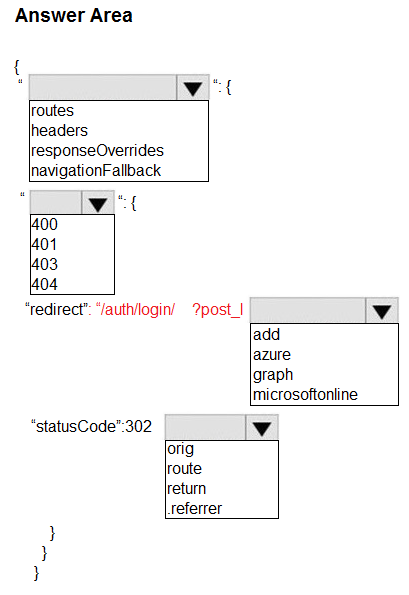
You are developing an Azure Static Web app that contains training materials for a tool company. Each tool’s training material is contained in a static web page that is linked from the tool’s publicly available description page.

A user must be authenticated using Azure AD prior to viewing training.

You need to ensure that the user can view training material pages after authentication.

How should you complete the configuration file? To answer, select the appropriate options in the answer area.

NOTE: Each correct selection is worth one point.

Correct Answer:


Question #148
HOTSPOT
-

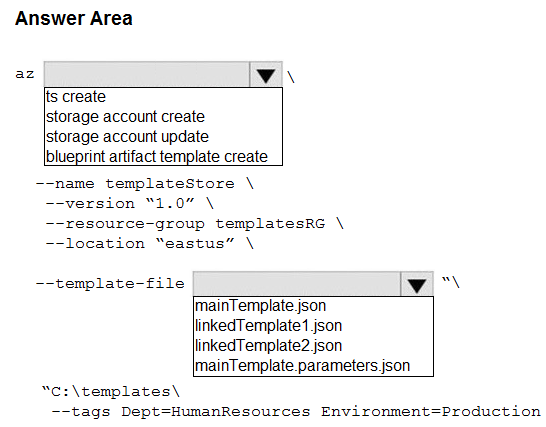
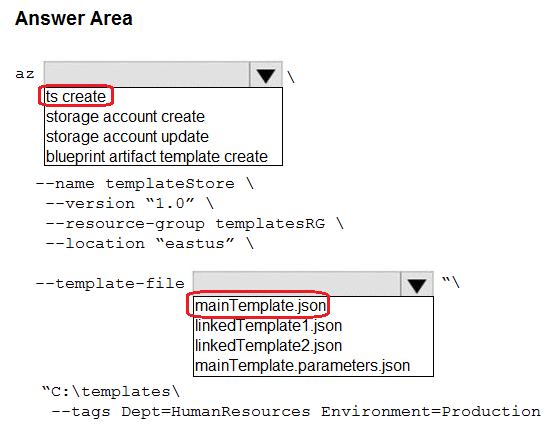
You are authoring a set of nested Azure Resource Manager templates to deploy Azure resources. You author an Azure Resource Manager template named mainTemplate.json that contains the following linked templates: linkedTemplate1.json, linkedTemplate2.json.

You add parameters to a parameters template file named mainTemplate.parameters,json. You save all templates on a local device in the C:\templates\ folder.

You have the following requirements:

• Store the templates in Azure for later deployment.
• Enable versioning of the templates.
• Manage access to the templates by using Azure RBAC.
• Ensure that users have read-only access to the templates.
• Allow users to deploy the templates.

You need to store the templates in Azure.

How should you complete the command? To answer, select the appropriate options in the answer area.

NOTE: Each correct selection is worth one point.

Correct Answer:

Question #149
HOTSPOT
-

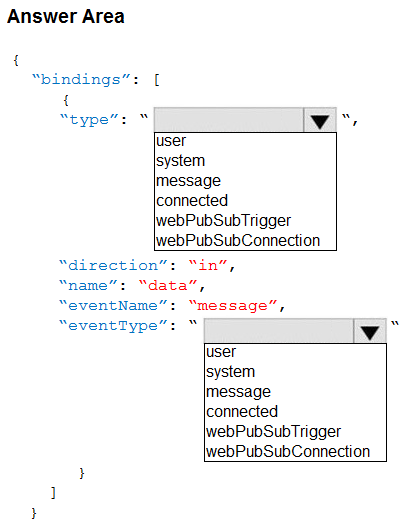
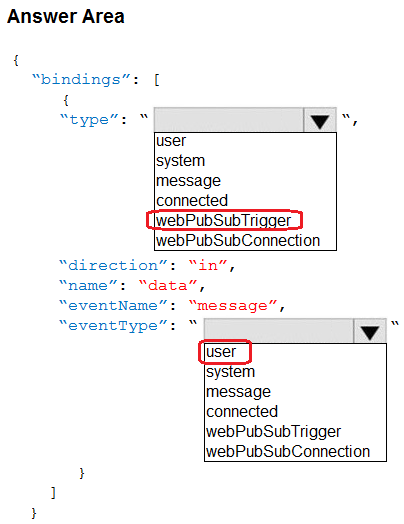
You are developing a service where customers can report news events from a browser using Azure Web PubSub. The service is implemented as an Azure Function App that uses the JSON WebSocket subprotocol to receive news events.

You need to implement the bindings for the Azure Function App.

How should you configure the binding? To answer, select the appropriate options in the answer area.

NOTE: Each correct selection is worth one point.
Correct Answer:


Question #150
HOTSPOT
-

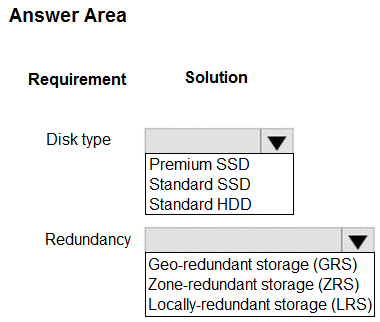
You are building a software-as-a-service (SaaS) application that analyzes DNA data that will run on Azure virtual machines (VMs) in an availability zone. The data is stored on managed disks attached to the VM. The performance of the analysis is determined by the speed of the disk attached to the VM.

You have the following requirements:

• The application must be able to quickly revert to the previous day’s data if a systemic error is detected.
• The application must minimize downtime in the case of an Azure datacenter outage.

You need to provision the managed disk for the VM to maximize performance while meeting the requirements.

Which type of Azure Managed Disk should you use? To answer, select the appropriate options in the answer area.

NOTE: Each correct selection is worth one point.
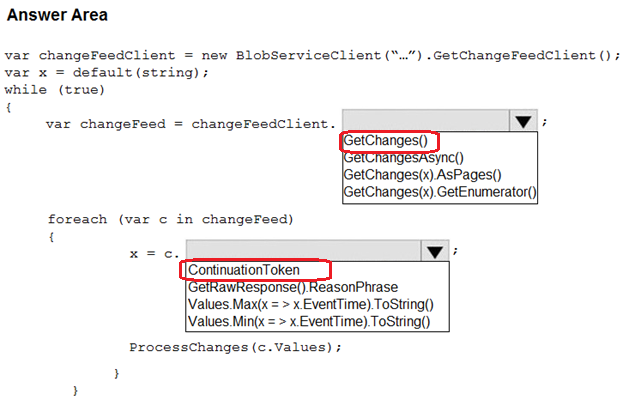
Correct Answer: